Investing in managed mango farmland in Konkan is one of the most compelling wealth-building goals for urban investors, yet it almost always brings up one practical question: “Who is going to manage the soil, protect the crop, harvest the fruit, and sell the produce?”
For most urban investors, owning a lush mango orchard in Ratnagiri is a compelling wealth-building goal, yet it almost always brings up one practical question: “Who is going to manage the soil, protect the crop, harvest the fruit, and sell the produce?”
Buying raw agricultural land is straightforward, but turning that land into a high-yielding, export-grade Ratnagiri Hapus (Alphonso) orchard while managing a career or business in Mumbai, Pune, or abroad is a major operational challenge. Traditional farmland ownership usually forces investors to face two hurdles: a 5 to 6 year waiting period for young saplings to bear fruit, and the year-round burden of labor supervision, climate risk, and wholesale market middlemen.
At Tathastu Mango Valley, we engineered both hurdles out of the investment model.
Every 1-acre plot (40,000 sq.ft) comes pre-planted with 30 to 40 mature, fruit-bearing Ratnagiri Alphonso trees. Instead of waiting half a decade for saplings to grow, your orchard has the biological scale to produce commercial harvest volumes from Year 1. More importantly, your estate is powered by a vertically integrated ecosystem: Konkan Agronomics executes scientific orchard management on the ground, while Fantastic Mangoes, our independent direct-to-consumer (D2C) retail brand, handles post-harvest grading, natural ripening, and direct retail monetization.
Here is how our harvest economics and scientific agronomy practices work together to deliver a 7.00% to 9.00% annualized agricultural yield with zero operational stress for the landowner.
The Harvest & ROI Engine: Why Managed Mango Farmland in Konkan Outperforms Traditional Real Estate
Most managed farmland projects on the market sell bare land planted with infant saplings. During the first five years, those plots generate zero revenue while requiring continuous cash outflows to keep the young plants alive.
At Tathastu Mango Valley, your capital is deployed into an already productive biological asset. Rather than exposing you to the trial-and-error costs of independent farming, our commercial structure is built around four core wealth drivers:
1. Immediate Harvest Scale (1,200 to 1,920 Dozens Per Acre)
Because each 1-acre parcel houses 30 to 40 mature Ratnagiri Hapus trees with fully developed canopies, the orchard skips the gestation phase entirely. A healthy, scientifically managed acre at Tathastu Mango Valley produces an estimated 1,200 to 1,920 dozens of authentic Ratnagiri Alphonso mangoes annually.
2. A Self-Funding Operational Structure
One of the biggest hidden traps in second-home and farmland ownership is the recurring monthly maintenance bill. At Tathastu Mango Valley, landowners never pay out-of-pocket maintenance invoices. All year-round agronomic inputs, irrigation, crop protection, skilled labor, harvesting, and professional farm management are funded directly through a pre-agreed share of the seasonal harvest revenue.
Once the season’s operational and management costs are covered from the harvest itself, the landowner receives ₹3.57 Lakh to ₹4.59 Lakh in net pure profit per acre annually.
3. 7.00% to 9.00% Tax-Exempt Annualized Agri-Yield
Urban residential apartments in tier-1 cities like Mumbai and Pune typically generate gross rental yields of just 2.5% to 3.5%, which shrink even further after accounting for society maintenance, property taxes, brokerage, and up to 30% income tax.
By contrast, your orchard at Tathastu Mango Valley delivers a 7.00% to 9.00% annualized agri-yield. Because agricultural income in India is exempt from income tax under Section 10(1) of the Income Tax Act, your net yield goes directly toward compounding your wealth.
4. Dual-Engine Wealth Creation
Importantly, this 7.00% to 9.00% annualized return is generated purely from mango sales, excluding land appreciation. While the annual harvest provides steady, inflation-hedged cash flow, your underlying 1-acre (40,000 sq.ft) freehold land parcel independently appreciates in capital value as infrastructure and highway connectivity expand across the Konkan belt.
Want to Review the Detailed Financial Breakdown?
To protect our proprietary pricing benchmarks and operational cost ratios, we share our complete financial modeling privately with registered investors. Contact Us to see our per-dozen realization benchmarks, revenue-sharing structure, and multi-year cash flow projections.
Precision Horticulture: How Konkan Agronomics Maximizes Your Harvest
Achieving 1,200 to 1,920 dozens per acre year after year requires moving away from traditional guesswork and implementing precision horticulture. Left to conventional methods, mango orchards in the Konkan region frequently suffer from “alternate bearing” (producing a strong crop one year followed by a dormant year), fungal outbreaks from unseasonal coastal humidity, or high post-harvest spoilage.
Konkan Agronomics eliminates these vulnerabilities through five year-round scientific protocols:
1. Coastal Red Laterite Soil Science & Micronutrient Balancing
The world-renowned aroma, saffron-colored pulp, and thin skin of a GI-tagged Ratnagiri Hapus are directly linked to Konkan’s mineral-rich, porous red laterite soil. However, laterite rock is naturally acidic and prone to nutrient leaching during heavy monsoons.
- Soil & Leaf Tissue Diagnostics: Our agronomists perform scheduled soil and foliar analyses to regulate soil pH and calibrate macro-nutrients (Nitrogen, Phosphorus, and Potassium) alongside critical trace elements like Boron, Zinc, and Calcium. Maintaining precise Calcium and Boron levels is vital for preventing “spongy tissue” (internal fruit breakdown) and fruit cracking.
- Microbial & Organic Soil Enrichment: Rather than degrading the land with heavy synthetic chemicals, Konkan Agronomics enriches tree basins with organic vermicompost, neem cake, and beneficial bio-cultures (Trichoderma and Pseudomonas). These living microbes strengthen active feeder roots, improve water retention, and build natural resistance against soil-borne pathogens.
2. Canopy Architecture & Alternate-Bearing Prevention
When mature mango trees grow unchecked, dense inner branches block sunlight from reaching the center of the canopy. Dark, humid interiors trap coastal moisture, inviting mango hoppers and powdery mildew while cutting flowering potential by nearly half.
- Center-Opening Structural Pruning: Post-harvest pruning maintains an “open-umbrella” canopy architecture. This allows deep sunlight penetration across all fruiting branches and lets the Arabian Sea breeze naturally ventilate the orchard.
- Shoot Maturity Regulation: By managing post-monsoon vegetative flushes scientifically, Konkan Agronomics ensures that terminal shoots reach uniform physiological maturity before winter. This triggers synchronized, high-density flowering (Mohur) every single season rather than every alternate year.
3. Phenological Hydration & Drip Fertigation
Mango trees require exact moisture control tied to their biological growth stages. Excess water during late autumn triggers leaf growth instead of flowers, whereas water scarcity during spring fruit expansion causes premature fruit drop.
- Regulated Pre-Flowering Dormancy: Following the monsoon, trees undergo a carefully monitored dry spell to encourage floral bud differentiation.
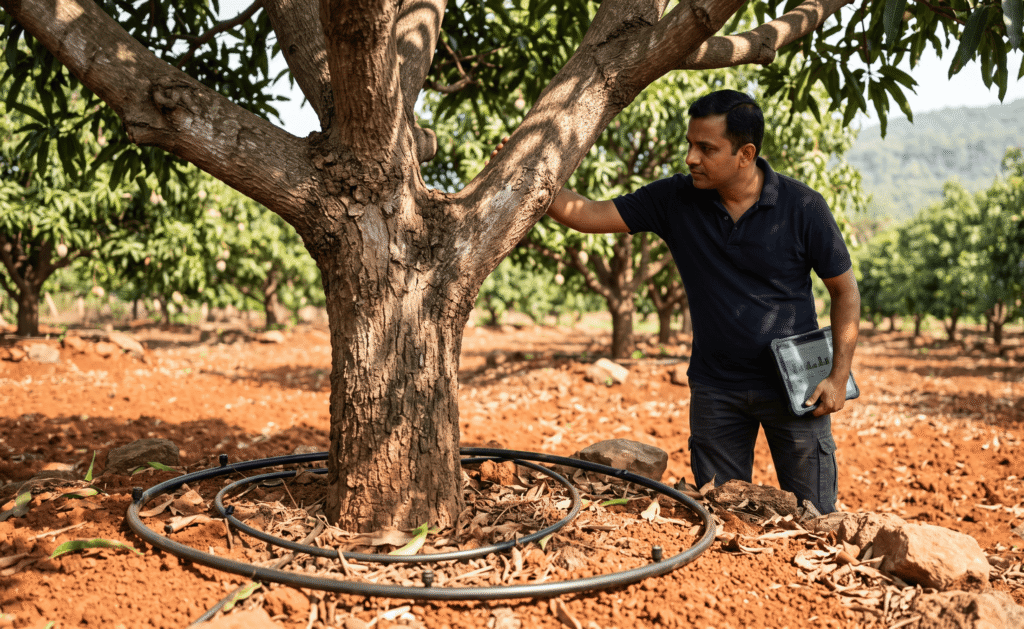
- Calibrated Root-Zone Fertigation: Once flowers set into “pea” and “marble” stage fruits, automated drip lines deliver measured hydration and water-soluble organic nutrients directly to the active root zone around the canopy drip line. This increases average fruit weight and pulp-to-stone ratio while conserving water.
4. Integrated Pest Management (IPM) & Protective Fruit Bagging
The 100 to 110 day window between flowering and harvest is when an orchard’s market value is decided. Sudden morning dew or temperature shifts can attract thrips, fruit flies, and anthracnose.
- Preventative Bio-Protection: Konkan Agronomics prioritizes residue-free Integrated Pest Management using pheromone traps, solar light traps, neem oil emulsions, and botanical extracts to neutralize pests early without compromising fruit purity.
- Individual Fruit Bagging: As fruits reach egg size, field teams enclose premium mango clusters inside breathable, multi-layered protective bags. Bagging physically shields the developing fruit from sunburn, bird damage, insect stings, and latex stains, yielding a spotless golden skin finish.
5. Scientific ‘Tapka’ Harvesting & De-Sapping Protocols
In traditional orchards, harvesting contractors strip trees rapidly to cut labor costs, mixing immature, starchy mangoes with mature ones. Worse, snapping a mango off its branch without a stem causes acidic sap to spurt onto the peel, creating black “sap burn” lesions that rot the fruit during transit.
- Specific Gravity Maturity Selection: Konkan Agronomics harvests in staggered rounds, selecting only fruits that have reached 85% or higher physiological maturity (traditionally called the Tapka stage). This guarantees optimal starch-to-sugar conversion and the signature Brix sweetness of true Ratnagiri Hapus.
- Stem-Intact Harvesting & De-Sapping Racks: Harvesters use cushioned poles fitted with shear blades to cut each mango with a 2 to 3 cm stem (pedicel) attached. Fruits are immediately placed stem-down on shaded de-sapping racks so the acidic latex drains completely away from the skin before the fruit ever touches a crate.
Closing the Loop: Farm-to-Consumer Monetization with Fantastic Mangoes
Superior agronomy is only half the equation. Even when a traditional farmer produces an exceptional crop, selling through fragmented wholesale markets (mandis) means surrendering a massive portion of the final retail value to chains of brokers, commission agents, and cold-chain middlemen.
At Tathastu Mango Valley, your orchard integrates directly with Fantastic Mangoes, our independent, full-stack D2C retail brand. Because Fantastic Mangoes operates as a standalone commercial brand with its own dedicated supply chain and direct customer base, your orchard’s harvest captures maximum market value:
- Precision Weight & Quality Grading: Every harvested fruit is sorted into strict weight and quality tiers (from standard 200g fruits to 300g+ king-size grades) so premium fruits command premium pricing.
- 100% Natural Paddy-Straw Ripening: Zero calcium carbide and zero artificial chemical ripeners are used. Mangoes cure naturally in breathable, traditional hay-lined chambers with controlled airflow to unlock their full aromatic profile and shelf life.
- Bespoke Packaging & Direct Fulfillment: Each mango is protected in foam netting, packed into custom-engineered, crush-proof Fantastic Mangoes boxes, and delivered directly to discerning households and corporate clients across India.
By uniting Konkan Agronomics on the farm with Fantastic Mangoes on the retail front, Tathastu Mango Valley transforms a complex agricultural operation into a predictable, hands-free financial asset.
Own a Cash-Flowing Orchard Legacy in Ratnagiri
Investing in farmland no longer requires choosing between idle land and a second full-time job. When you invest in Tathastu Mango Valley, you secure:
- 1 Acre (40,000 sq.ft) of Clear-Title Freehold Land: Complete 7/12 ownership in your name in the heart of Ratnagiri’s GI-tagged mango belt.
- 30 to 40 Mature Ratnagiri Hapus Trees: Pre-matured biological assets capable of yielding 1,200 to 1,920 dozens per acre annually without a 5-year wait.
- ₹3.57 Lakh to ₹4.59 Lakh Net Annual Profit: True passive cash flow after all operational and farm management costs are self-funded from the harvest.
- 7.00% to 9.00% Annualized Agri-Yield: Tax-exempt agricultural returns purely from mango sales, layered on top of long-term Konkan land appreciation.
Schedule a Private Site Visit to Tathastu Mango Valley or Request Our Private Investor Unit Economics Dossier and reserve your mature mango orchard plot today.
Unlike raw farmland planted with young saplings that take 5 to 6 years to bear fruit, every 1-acre (40,000 sq.ft) plot at Tathastu Mango Valley comes pre-planted with 30 to 40 mature Ratnagiri Hapus trees capable of yielding 1,200 to 1,920 dozens annually from the very first harvest season.
No. All year-round farming operations by Konkan Agronomics, including laterite soil nutrition, drip irrigation, fruit bagging, and harvesting, are self-funded directly from a pre-agreed share of the annual mango harvest revenue, leaving the owner with Rs 3.57 Lakh to Rs 4.59 Lakh in net annual profit per acre.
Your orchard’s harvest is graded, naturally hay-ripened without chemicals, packaged, and monetized through Fantastic Mangoes, our independent direct-to-consumer (D2C) retail brand, ensuring maximum realization without traditional middlemen.