For decades, Mumbai and Pune real estate investors followed a familiar playbook: accumulate capital, buy residential or commercial property in expanding metro suburbs, collect modest rent, and wait for long-term price appreciation. While that strategy built wealth in the early 2000s, today’s urban property market tells a very different story.
Sky-high entry prices in micro-markets from Thane and Navi Mumbai to Baner, Wakad, and Kharadi have compressed gross residential rental yields down to a stagnant 2.5% to 3.5%. Once you deduct society maintenance charges, property taxes, brokerage commissions, vacancy periods, and up to 30% in income tax on rental earnings, the actual net cash-on-cash return often drops below 2%.
Rather than locking up capital in low-yield urban concrete, a growing wave of discerning Mumbai and Pune real estate investors is reallocating capital down the coast into a higher-yielding asset class: pre-matured, scientifically managed Ratnagiri Alphonso orchards at Tathastu Mango Valley.
Here is an inside look at why smart urban capital is shifting toward managed mango farmland in Konkan, and how our vertically integrated ecosystem delivers a 7.00% to 9.00% annualized agricultural yield alongside rapid corridor appreciation.
The Urban Yield Trap vs. The Managed Orchard Advantage
When evaluating an investment asset, sophisticated property buyers look at four fundamental metrics: immediate cash yield, tax efficiency, operational friction, and capital appreciation. Here is how traditional metro property compares against a 1-acre (40,000 sq.ft) orchard estate at Tathastu Mango Valley:
1. 7.00% to 9.00% Annual Yield vs. 2.5% Urban Rental Yields
In Mumbai and Pune, property prices have outpaced rental growth for over a decade. Even when a residential property is occupied year-round, its annual rental yield barely beats savings account interest rates.
At Tathastu Mango Valley, every 1-acre freehold plot is an active biological production unit capable of generating ₹3.57 Lakh to ₹4.59 Lakh in net pure profit annually for the landowner, translating into a 7.00% to 9.00% annualized agri-yield. Crucially, this yield is calculated purely from mango sales, excluding land appreciation.
2. 100% Tax-Exempt Cash Flow Under Section 10(1)
Rental income from residential or commercial real estate in Mumbai and Pune is added directly to your taxable income slab. For high-earning professionals and business owners in the 30% tax bracket, nearly a third of every rent check goes straight to taxes.
Conversely, income generated from primary agricultural operations in India is 100% exempt from income tax under Section 10(1) of the Income Tax Act. A 7.00% to 9.00% return at Tathastu Mango Valley is a true post-tax return, making it equivalent to earning a 10% to 13% pre-tax yield in a taxable urban instrument.
3. Zero Tenant Turnover & Self-Funding Maintenance
Every urban landlord knows the hidden headaches of metro property ownership: negotiating lease renewals, funding repainting and repairs between tenants, dealing with society committees, and paying recurring monthly maintenance bills whenever a unit sits vacant.
At Tathastu Mango Valley, there are no tenants to chase and zero out-of-pocket maintenance bills to pay. All year-round farming operations, soil nutrition, irrigation, crop protection, and harvesting are self-funded directly out of the seasonal harvest revenue before your net profit is disbursed.
Why Mumbai and Pune Real Estate Investors Demand Zero-Gestation Orchards
Historically, when urban investors looked at managed farmland around Maharashtra, they walked away for one valid reason: the 5-to-6-year waiting period.
Most farmland developers sell raw agricultural plots planted with infant saplings. For the first five years, those saplings produce zero commercial fruit while demanding continuous capital injections to survive harsh monsoons and summer heat.
Tathastu Mango Valley was engineered specifically for return-focused investors who refuse to wait half a decade to see cash flow:
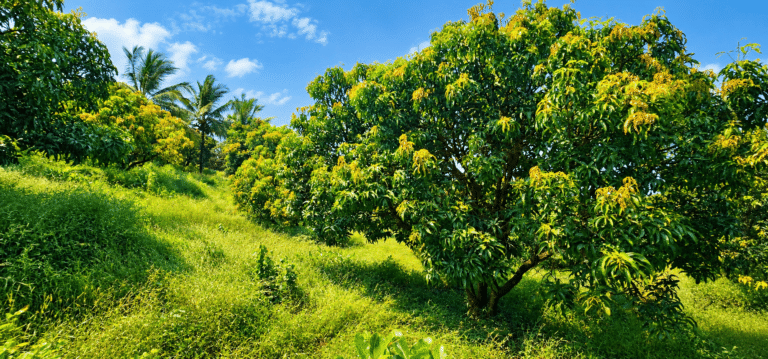
- 30 to 40 Mature Ratnagiri Hapus Trees Per Acre: Every 1-acre (40,000 sq.ft) parcel comes pre-planted with established, fruit-bearing Alphonso trees with mature canopies.
- 1,200 to 1,920 Dozens Annual Harvest Potential: Because the trees are already in their prime productive phase, a single acre yields between 1,200 and 1,920 dozens of authentic GI-tagged Ratnagiri Hapus annually right from Year 1.
- Clear 7/12 Freehold Title: You enjoy complete legal ownership of the underlying 1-acre parcel, giving you the security of tangible real estate combined with the cash flow of an operating agribusiness.
Request the Private Investor Comparison Dossier Want to see a side-by-side 10-year financial projection comparing a Mumbai/Pune property allocation against a 1-acre plot at Tathastu Mango Valley? Download Our Confidential Unit Economics & ROI Prospectus to review our complete revenue-sharing model and harvest realizations.
Turnkey Execution: How Konkan Agronomics and Fantastic Mangoes Protect Your Yield
For Mumbai and Pune real estate investors, distance is the biggest barrier to owning rural land. You cannot step away from your corporate role or business every week to supervise farm labor in Ratnagiri or negotiate with wholesale fruit traders.
Tathastu Mango Valley solves the absentee-owner problem through two dedicated operating arms that manage the entire value chain from soil to consumer:
Step 1: Precision Orchard Management by Konkan Agronomics
Rather than relying on unorganized local labor, Konkan Agronomics applies institutional-grade horticulture across every acre:
- Coastal Red Laterite Soil Optimization: Periodic soil and leaf-tissue diagnostics balance pH levels and replenish essential micronutrients (Boron, Zinc, Calcium) alongside organic vermicompost and beneficial soil microbes. This prevents internal fruit defects and maintains tree vigor.
- Canopy Architecture & Yearly Fruiting: Unmanaged orchards suffer from “alternate bearing” (fruiting one year and resting the next). Our agronomists execute center-opening structural pruning after harvest to maximize sunlight penetration and regulate shoot maturity, ensuring consistent annual flowering (Mohur).
- Phenological Drip Fertigation: Automated root-zone drip irrigation delivers calibrated moisture and water-soluble organic nutrients during critical fruit-set and fruit-expansion stages.
- Protective Bagging & Stem-Intact Harvesting: Developing mango clusters are enclosed in breathable protective bags to prevent sunburn, pest damage, and latex marks. At harvest, fruits are hand-cut at 85%+ physiological maturity (Tapka stage) with a 2 to 3 cm stem attached and placed on shaded de-sapping racks to guarantee export-grade quality.
Step 2: Direct-to-Consumer Monetization by Fantastic Mangoes
Growing premium fruit is pointless if the harvest is dumped into traditional wholesale markets (mandis), where layers of commission agents and brokers swallow the profit margin.
Your orchard at Tathastu Mango Valley plugs directly into Fantastic Mangoes, our independent, full-stack D2C retail brand. Operating as a standalone commercial brand with its own supply chain and end-consumer base, Fantastic Mangoes maximizes the market value of your crop:
- Strict Weight & Quality Grading: Fruits are sorted into precision weight tiers (from standard 200g grades to 300g+ king-size fruits).
- Natural Paddy-Straw Ripening: Every mango is naturally cured in breathable hay-lined chambers without calcium carbide or artificial chemicals.
- Direct Retail Fulfillment: Packed in custom-engineered, crush-proof gift boxes, the harvest is shipped directly to premium households across Mumbai, Pune, and pan-India.
By capturing the full farm-to-consumer margin without external middlemen, this vertically integrated loop reliably generates ₹3.57 Lakh to ₹4.59 Lakh in net annual profit per acre for our landowners.
The Konkan Infrastructure Boom: Why Ratnagiri Beats Saturated Hill Stations
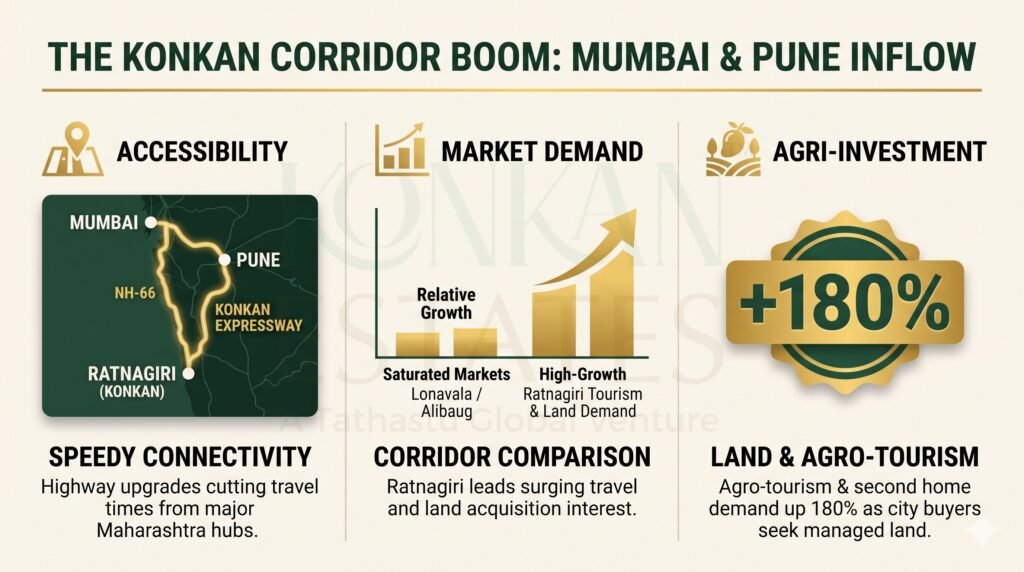
A decade ago, investors from Mumbai and Pune flocked to Lonavala, Khandala, Alibaug, and Karjat for second homes and land banking. Today, land prices in those saturated pockets have peaked, leaving limited room for exponential appreciation.
Ratnagiri now sits at the exact inflection point where Alibaug and Lonavala stood fifteen years ago, backed by massive state and central infrastructure upgrades:
- NH-66 (Mumbai-Goa Highway) Expansion: Ongoing four-laning, concrete carriageway upgrades, and new tunnels along NH-66 are steadily cutting drive times from Navi Mumbai, Panvel, and Pune into the Ratnagiri belt.
- The Proposed Konkan Greenfield Expressway: Modelled on the Mumbai-Nagpur Samruddhi Mahamarg, the upcoming 6-lane access-controlled Konkan Expressway is set to transform connectivity between Mumbai and the southern Konkan coast, unlocking rapid capital appreciation for early landowners.
- Scarcity of GI-Tagged Terroir: While apartments can be built endlessly across urban skylines, the porous red laterite soil and coastal micro-climate required to grow authentic GI-tagged Ratnagiri Hapus exist only in a finite geographic belt. You are acquiring a supply-capped natural monopoly.
Diversify Your Portfolio Beyond Urban Concrete
You do not need to abandon urban real estate altogether, but allocating a portion of your property portfolio into a high-yielding, tax-free biological asset transforms your overall return profile.
When you invest in Tathastu Mango Valley, you secure:
- 1 Acre (40,000 sq.ft) of Freehold Land: Clear, marketable 7/12 title in Ratnagiri’s prime mango corridor.
- 30 to 40 Mature Ratnagiri Hapus Trees: Producing 1,200 to 1,920 dozens annually with zero gestation wait.
- ₹3.57 Lakh to ₹4.59 Lakh Net Annual Profit: Self-funded operations managed entirely by Konkan Agronomics and Fantastic Mangoes.
- 7.00% to 9.00% Tax-Exempt Agri-Yield: Outperforming metro rental yields from Year 1, purely from mango sales and excluding land appreciation.
- A Private Weekend Sanctuary: Build your own orchard retreat just a scenic drive from Mumbai and Pune, and enjoy boxes of estate-grown Ratnagiri Hapus delivered to your home every summer.
Lock in your 1-acre mature orchard plot today